Every B Corp™ has a story. Here’s mine.
I started my career in not-for-profit land: big on mission, modest on pay, and high on burnout. After nearly a decade of incredible campaigns and inspiring people, I hit 30 and I was cooked. My hope was a little charred, my convictions a little shaken, and I was only ever one unexpected bill away from a full-blown panique attaque.
Deep in my gut, I knew I needed to tip my life upside down like a handbag and shake everything out to see where it landed.
Of course, I was never going to do a 180 and work with organisations propping up the very systems I’d been campaigning against just to feel financially safe. I wanted to stay in the fight for justice and equality, but I needed a version of it that was more sustainable, both energetically and economically.
That’s when I heard about these things called ‘B Corps’.

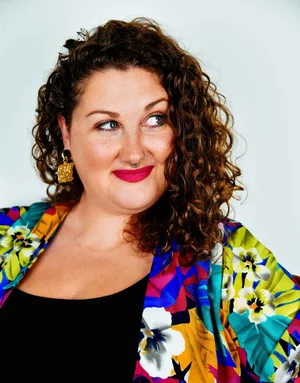
Photo by Sally Batt Photography
Finding my place in the movement
In early 2019, I went looking for an Aussie B Corp who wanted a part-time internal comms person while I built my business and restored my strength. I found my way to creative agency and impact production house, Digital Storytellers, and got a front-row seat to what being a B Corp looks like in practice; values-led, excellent at your craft, and not shy about making money the right way so you can do more of what you do best.
From there, I worked with the phenomenal team at Pure Finance to communicate their impact as they moved towards certification and I was fully, officially hooked.
This movement had the same heart I’d found in the NFP world. The same appetite for systems change, innovation, and smashing the status quo. But with a crucial extra ingredient: a model capable of generating an income to keep the lights on and fires burning, day after day.
I want to name clearly that NFPs + NGOs play a vital role in our societal ecosystem, filling gaps and providing services that either government or the private sector can’t or won’t. It just wasn’t for me, anymore.
Making the most of your moment
Over the last 7 years, I’ve worked with a wide range of B Corps and aspiring B Corps, from community-owned banking to responsible fashion, helping businesses connect their work to the bigger picture and communicate with integrity. Campaigns, messaging, long-form content, impact storytelling, the lot.
Along the way, I’ve met some of the sharpest, most values-driven people going around and I’ve also had the very cool opportunity to work with the B Lab Australia and Aotearoa New Zealand team itself (the non-profit that leads the B Corp movement) , helping localise the movement’s tone and agenda in our region.
Then, in 2024 at Assembly (the regional gathering of B Corps), I had a real “I’m sick of peering in through the glass” moment.
Listening to keynotes, attending workshops, documenting the experience. I realised this is a movement built on the back of people exactly like me. People who are willing to do the work, and do better business; those who take personal and collective responsibility to transform the global economic system from the inside out, and the outside in.
The best part, to me, was that effort or ‘how’ to go about achieving this systemic change didn’t look just one way. It cut across dozens and dozens of industries, countries, and business models, with organisations of all sizes and shapes.
Doing the work, now with greater purpose
Going on the certification journey as a sole trader is no joke. It took me just over a year (and a career) to go through the process before getting certified in March 2025.
I worked with a magnificent B Consultant (Elana Robertson, foundher.) who helped me make sense of the requirements for my business.
I documented the processes I’d been doing by instinct for years, and added a few more.
I gathered receipts and started tracking a bunch of metrics that could speak to the value and impact I create.
I put more structure and systems around how I work and who I work with, committing to an Impact Business Model by which I work with a minimum of 70% purpose-driven clients and commit 5% to pro-bono and low-bono projects for social and environmental causes such as The Global Women’s Project, Clothing The Gaps and Ladies Talk Money.
And I formalised commitments to redistribute resources and opportunity through paying the rent to First Nations organisations and 1% for the Planet.
'B' stands for 'benefit' to all people and the planet
〰️
'B' stands for 'benefit' to all people and the planet 〰️
Did certifying as a B Corp actually change the way I do business?
Lots of people say becoming a B Corp is just “making official” what they were already doing. I get it. But I think it overlooks how much the movement and the standards themselves shape you.
Because even though I’ve always done my best to run a feminist business and decolonise my practice, there hadn’t been anyone checking my homework. You just had to take my word for it. And while I work hard to make sure my word (and my words) always count for something, there’s a limit to how far “trust me” can (and should) take you.
In my humblest of opinions, good intentions aren’t a methodology and they are incredibly subjective. Values aren’t real until they’re articulated, resourced, measured, and tested under pressure.
So becoming a B Corp wasn’t about proving I’m “good”. Again, that’s so subjective and a bit pious. It was about building a business that can be held to account. One that’s structured to live its values even on the busy weeks, the low-cashflow months, the days when the shortcut is tempting.
It meant turning instincts into policies. Turning “I try” into “here’s how”. Turning a personal ethic into a set of commitments you can actually interrogate. Not just me saying the right things, but a way for my work to hold up when someone looks closely.
And honestly, as a sole trader, that kind of rigour is both revealing and weirdly relieving.
Being willing to show your working
Going through the assessment and verification process forces you to look at the structural bones of your business, not just the shiny parts. They nudge (and sometimes shove) you into being more conscious and deliberate about how you run your business. They give you language for the instincts you’ve had, and frameworks that make you tighten the screws.
Over the past 20 years, this movement of 10,000+ businesses has normalised and standardised measuring social and environmental impact across industry and across borders.
It’s made transparency the baseline and accountability part of the corporate lexicon. It’s put human rights, supply chains, governance and community impact on the agenda in rooms that used to only speak fluent profit. And it’s made it untenable for “good intentions” to be enough.
Raising the bar for better business
Being a B Corp is about raising the bar and shifting the baselines. Certification isn’t the end game, continuous improvement is. Earning the badge isn’t the point, accountability is.
Is it perfect? Absolutely not. It’s a movement made up of humans trying to survive manmade systems that are eating our planet alive.
But I’ll take imperfect effort with a bucketful of receipts over polished words with no proof any day of the week (and twice on my B day).
Because right now we need every scrap of credible hope and progress we can get. And I’m proud to be part of a movement that goes beyond good intentions and tries to build something better.